
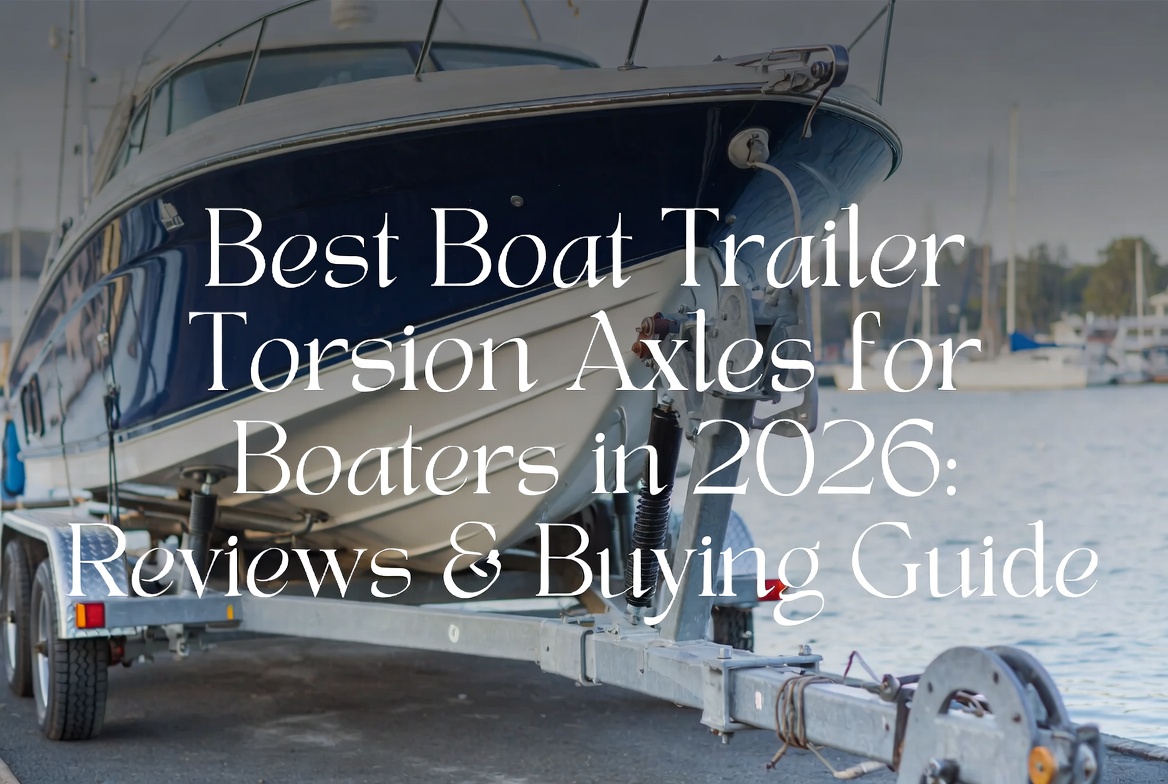
Choosing the right boat trailer torsion axles is one of the best upgrades you can make for smoother towing, reduced maintenance, and improved on-road handling. This guide walks you through what torsion axles are, how to size and spec them, installation and maintenance tips, common pitfalls, and recommended complementary trailer hardware — including transom tie-downs and mounting kits recommended for boaters.
Affiliate disclosure: Some of the products mentioned in this article are affiliate-linked. If you buy through those links we may earn a small commission at no additional cost to you. We only recommend products we use or trust for marine trailer use.
 Who it’s best for: Budget-conscious owners who want a reliable pair of self-retracting ratchet straps for light to mid-weight boats. Key strengths: self-retracting ratchet design reduces strap drag and keeps straps off the road. Possible drawbacks: may not include stainless hardware for long-term saltwater exposure. Choose this set if you want a ready-to-install pair for freshwater or occasional brackish use.
 Who it’s best for: Boaters who trail in salt or brackish water and want a durable, permanent transom solution. Key strengths: BoatBuckle G2 Stainless features one-bolt permanent installation and stainless steel construction built for corrosion resistance. Possible drawbacks: higher price; professional install recommended for permanent mounting. Choose for long-term reliability and low maintenance.
 Who it’s best for: Owners fitting retractable straps who need flexible mounting options. Key strengths: universal mounting bracket kit supports a broad range of BoatBuckle and similar retractable straps. Possible drawbacks: brackets are basic steel—consider stainless options for ocean use. Choose when you want a simple bolt-on mounting solution.
 Who it’s best for: Freshwater boaters wanting a balance of price and function. Key strengths: Rhino USA retractable straps are powder-coated for corrosion resistance and bolt-on ready. Possible drawbacks: not rated for heavy saltwater exposure long-term. Choose for reliable everyday trailering in freshwater regions.
 Who it’s best for: Owners who prefer higher break strength and increased holding power. Key strengths: Upgraded break strength and higher safe working load make this pair suitable for heavier boats. Possible drawbacks: heavier-duty straps can be bulkier; ensure mount points are solid. Choose when towing heavier craft or when you want greater margin for safety.
 Who it’s best for: Owners looking for an affordable non-retractable pair for basic trailering needs. Key strengths: Simple and easy to use, American-owned brand. Possible drawbacks: lacks retractable convenience and permanent mounting features. Choose for light use and as a handy spare or secondary tie-down.
Check All Boat Trailer Torsion Axels Models
Quick summary — Who this guide is for
This guide is for boat owners who tow regularly and want a quieter, lower-maintenance trailer suspension than traditional leaf springs. It’s especially useful for:- Owners of boats and pontoons where ride comfort matters (fishfinder electronics, livewells, fragile gear).
- Trailers that spend lots of time on highways or rough roads.
- Owners replacing worn leaf springs or upgrading axle capacity for heavier boats.
- DIY mechanics planning to measure, order, and install torsion axles themselves or for owners who need to spec new axles when buying a trailer.
What is a torsion axle and why many boaters choose it
Torsion axles are a self-contained suspension system — each axle contains internal rubber cords (or rubber-in-shear components) inside a square or round housing. The stub axle (spindle) is attached to the housing via splines and rubber. When the wheel moves up or down, those rubber cords twist inside the housing and absorb the motion, acting as the “spring” and dampener at the same time. Key advantages for boaters:- Smoother ride with less axle tramp and vibration transmitted to the boat.
- Independent action — a bump on one side doesn’t jolt the whole trailer.
- Often lower maintenance: no leaf pack to wear or shackle bolts to inspect repeatedly.
- Clean look and ability to fit disc brakes and sealed hubs easily.
When not to choose torsion axles
Torsion axles are not always the ideal choice. Consider leaf springs if:- You need very low cost replacement parts in remote areas — leaf springs are ubiquitous and easy to source.
- Your trailer is frequently overloaded beyond rated capacities (replace capacity instead of overloading).
- You have a custom application where extreme articulation is required (some severe off-road trailers).
How to choose the right torsion axle: key specs explained
Buying a torsion axle means matching multiple measurements and ratings to your trailer and boat. Here are the items to check and why they matter.- Axle capacity (per axle): Expressed in pounds (e.g., 2,000 lb, 3,500 lb, 5,200 lb). Add the capacity of all axles and keep your trailer GVWR (including boat, gear, fuel) below that combined number with a safety margin.
- Number of axles: Two 3,500-lb axles give you 7,000 lb capacity; one 5,200-lb axle offers similar capacity but different ride and distribution. Choose based on tongue weight, trailer length, and legal axle spacing.
- Hub face / track width: Hub face (distance between wheel faces) and track width dictate wheel placement. Match rims and tires and ensure fender clearance.
- Brake type and compatibility: Most torsion axles are offered with or without brakes, and with electric or surge brake-ready spindles. If you need disc brakes, confirm the axle has disc-ready stub spindles.
- Spindle type and spline pattern: Verify the spline count and diameter matches your hubs or order matching spindles/hubs. Many torsion axles use standardized splines but double-check.
- Finish and corrosion protection: Marine use demands galvanization, powder coat plus marine-grade paint, or stainless components on critical fittings to avoid rust in salt/brackish water environments.
- Ground clearance and suspension travel: Consider boat clearance at the lowest point and ramp/dock angles. Torsion axles typically have less travel than leaf springs but offer a lower profile.
- Axle length and drop/offset: Some torsion axles are straight, some have a drop or offset. Measure existing axle and trailer layout carefully when replacing.
How to measure your trailer for torsion axle replacement
- Weigh your trailer fully loaded at a public scale to calculate required GVWR and safety margin.
- Measure hub face-to-hub face (outside wheel face to outside wheel face) or center-to-center of hubs to match track width.
- Measure the distance from the center of hub to the center of the trailer frame (useful for finding the correct spring center on leaf springs, but for torsion axles you’ll need the hub mounting position and stub length).
- Note brake type, wheel bolt pattern, and hub face dimension (to make sure wheels/fenders align).
- Measure frame tube size and thickness where the axle housing will mount — mounting brackets and spindle orientation depend on trailer frame dimensions.
Comparison checklist before you buy — quick reference table
| Feature | What to look for | Why it matters |
|---|---|---|
| Axle rating | Pick capacity ≥ trailer loaded weight / number of axles | Prevents overloading and early failure |
| Brakes | Electric or disc-ready; specify if needed | Matching brake type ensures safety and compliance |
| Finish | Galvanized or marine-grade coating | Prevents corrosion in salt/brackish water |
| Hub face / track | Measure accurately to fit wheels and fenders | Avoids wheel rub and handling issues |
Installation basics and common adjustments
Installing torsion axles can be a weekend DIY for a mechanically inclined boater, but it does require careful measurement and proper tools. Key steps:- Support trailer securely and remove wheels and hubs if needed.
- Remove old axle assembly (keep hardware and brackets if they’re reusable and in good condition).
- Fit new torsion housing into trailer frame channel or mount brackets; center it per manufacturer instructions.
- Torque mounting bolts to spec and align hubs so wheel faces are parallel and fender clearance is correct.
- Install brakes and adjust; repack bearings or install new sealed hubs as needed.
- Lower trailer, check ride height, and test on a short drive with light load before full use.
Maintenance: keep torsion axles working for years
- Inspect mounting bolts annually and after any heavy tow.
- Check for rust and touch up paint; keep drainage holes clear of debris.
- Monitor for uneven tire wear — could indicate alignment, bent spindle, or worn housing.
- Hubs and bearings still need attention: use sealed hubs where possible; if using serviceable hubs, repack or replace bearings per interval.
- Watch for signs of internal rubber failure (hard to see). If you notice sagging on one side, binding, or odd ride characteristics, consult a trailer shop — axles can be rebuilt but are often replaced if damaged.
How torsion axles perform with brakes and hubs
Torsion axles work with most hub/brake systems — electric drum, hydraulic surge, and disc brakes. If you plan to use disc brakes, verify that the torsion axle stub spindles are disc-ready (flat face and correct spline). Also check wheel bolt pattern and hub face dimensions so your wheels and brake calipers clear fenders.Common mistakes to avoid
- Under-specifying axle capacity — always allow a margin for weight growth and fuel.
- Mismatching hub face or wheel bolt pattern — results in reworks and extra cost.
- Ignoring corrosion protection — salt spray quickly defeats cheap powder coat finishes.
- Installing without aligning track/center — misalignment causes tire wear and poor handling.
- Assuming torsion axles don’t need inspection — they are lower maintenance, not no maintenance.
Complementary trailer gear — tie-downs, brackets, and what to use with torsion axles
Even the best axle needs good trailer rigging. Transom straps keep the boat mounted and prevent bounce during transport. Here are industry-proven tie-downs and mounting kits available through US Nautics that pair well with torsion-axle-equipped trailers.Top transom and tie-down options
Recommended Pick
Boat Tie Down Straps to Trailer 2 x…
Self-Retracting Ratchet Design: This innovative ratchet straps self retractable is both simple and efficient to use. Just pull the strap to the desired length and secure it with the ratchet handle. Once secured, place the handle in the…$55.41View Product
Recommended Pick
BoatBuckle G2 Stainless Steel Retra…
BoatBuckle G2 Stainless revolutionizes trailer boat rigging with its innovative self-retracting design and simple one-bolt permanent installation. Ideal for securing your boat during transport, this retractable transom tie-down system is crafted from stainless steel, ensuring durability even in…$120.46View Product
Recommended Pick
BoatBuckle F14254A Universal Mounti…
Universal Mounting Bracket for Flexible Mounting Options – This also fits BoatBuckle and CargoBuckle Models: F106877EC, F106877, F14221A, F14221, F14220EC, F14393, F14393A, F08893, F08893EC,F14256, F14256EC, F18800, F18800EC, F103745, F103745EC. 3-sided Bracket for Flexible Mounting – Built for professionals…$17.55View Product
Recommended Pick
Rhino USA Retractable Boat Transom …
BOLT-ON TRAILER MOUNT INSTALLATION – Bolts to Square Tube and Channel Iron Trailer Frames Using Included 3/8in Hardware. Trailers Without Pre-Drilled Holes Require a 3/8in Drill Bit. Measure Frame Thickness to Confirm Bolt Fit. FRESHWATER BOAT TRAILER AND…$65.88View Product
Recommended Pick
Retractable Boat Transom Tie Down S…
Upgraded High-Strength Holding Power for Confident Trailering: Built to go beyond basic tie-down performance, these retractable transom straps deliver a 2,500 lbs break strength and 833 lbs safe working load limit to help keep your boat locked down…$82.68 Original price was: $82.68.$67.72Current price is: $67.72.View Product
Recommended Pick
Rhino USA Boat Transom Straps (2-Pa…
AMERICAN OWNED, FAMILY OPERATED – Join the Rhino USA Family and Support a Father/Son Business With the Best USA-Based Customer Support. UNIVERSAL FITMENT – Versatile Design Ensures Compatibility With all Marine Trailers Featuring Tie-Down Points, Whether you are…$26.30View Product
How to pair tie-downs and brackets with torsion axles
When installing transom straps on trailers with torsion axles, remember:- Attach straps to the trailer frame, not to axle parts. Mounting to the torsion housing risks damage and incorrect load paths.
- Use one-bolt or bracket-mounted retractors where possible to prevent straps dragging or snagging.
- Consider stainless hardware and marine-grade mounting plates in saltwater environments.
- Replace straps and hardware showing UV or abrasion damage — straps are safety items and wear out.
Practical buying checklist before you order a torsion axle
- Confirm trailer’s fully loaded weight at a scale.
- Decide required axle capacity and number of axles (include safety margin).
- Measure hub face, bolt pattern, and fender clearance.
- Choose brake configuration — electric drum, disc-ready, or no brakes.
- Pick corrosion-resistant finish if you trailer in salt/brackish water.
- Confirm spindle spline and hub compatibility or buy matching hubs.
- Arrange for professional installation if you’re not fully comfortable with alignment and torquing specs.
Final recommendations — what to choose based on your needs
- For light freshwater boats and simplicity: 2,000–3,500 lb torsion axles with basic powder coat finish and electric drum brakes are cost-effective and quiet.
- For salt or brackish water and long-term durability: Choose galvanized housings or axles with marine-grade coatings and stainless mounting hardware; combine with stainless BoatBuckle G2 retractables for transom security.
- For heavy boats: Two 3,500-lb axles or a single 5,200-lb axle (depending on trailer configuration) with disc-ready spindles and appropriately rated hubs/wheels.
- For DIY installers: Double-check spline patterns and hub face measurements — buy matching hubs and sealed bearings to reduce maintenance.
FAQ — practical questions boaters ask about torsion axles
1. How do I know what axle capacity I need?
Weigh your trailer fully loaded (boat, fuel, gear, trailer). Divide required GVWR by the number of axles. Choose axle capacity per axle that meets or exceeds that number with a safety margin (10–20%). Account for future increases in gear or fuel load.2. Are torsion axles better than leaf springs?
Torsion axles offer a smoother ride, better damping, and less maintenance in many cases. Leaf springs are simpler and often cheaper to source/repair. Choose torsion axles for smoother road performance; choose leaf springs if you need low-cost field-replaceable parts or extreme articulation.3. Can I use my existing wheels and hubs with new torsion axles?
Possibly — but you must match bolt pattern, hub face, and spindle spline. If you’re unsure, measure wheel bolt pattern and hub face and check with the axle vendor. Buying matched hubs and sealed bearings is often easier and ensures compatibility.4. How long do torsion axles last?
Life depends on use, loading, and environment. Well-maintained torsion axles with good corrosion protection often last many years. Saltwater use shortens life if corrosion protection is inadequate. Regular inspections and attention to seals, hubs, and mounting hardware extend useful life.5. Can I install torsion axles myself?
Yes, if you’re comfortable measuring, aligning, lifting heavy components, and torquing to spec. Many owners can replace axles themselves, but if you’re uncertain about alignment, brakes, or hub work, a professional installation is safer and avoids costly mistakes.6. How do I tell if a torsion axle is failing?
Symptoms include sag on one side, noisy operation, uneven tire wear, or excessive vibration. Internal rubber can deteriorate; if you suspect failure, have the axle inspected by a trailer professional. Don’t ignore signs — a failing axle affects handling and safety.7. Are torsion axles serviceable or rebuildable?
Some torsion axles can be rebuilt by specialists who replace internal rubber components, but many owners choose to replace the axle housing. Replacement is often simpler and widely available; for rare axles, rebuilding may be more cost-effective.Final checklist before towing after an axle swap
- Torque all mounting bolts to manufacturer specs after first 50–100 miles and recheck at 500 miles.
- Adjust brakes and verify operation on a short test run.
- Re-inspect tire pressure and lug torque after initial run.
- Confirm fender clearance and check that tie-down straps are attached to the trailer frame (not axle housing).
Where to buy and find parts
Specialized trailer shops, OEM axle suppliers, and many marine retailers supply torsion axles. If you’re buying online, choose vendors who list full specs (axle rating, spline pattern, hub face, and brake options) and who accept returns or offer technical support.Check All Boat Trailer Torsion Axels Models
Related US Nautics resources
- Best Boat Winch for Boaters in 2026 — matching winches help load/unload with less stress on trailer suspension.
- Best Boat Rollers for Trailers in 2026 — optimize support and alignment with your new axle setup.
- Best Boat Leaning Posts for Boaters — accessories to improve comfort and safety onboard.
- Boat Covers and Storage — proper storage reduces corrosion stress on trailers and axles.
- Boat Bilge Pumps — maintain your boat to reduce weight and shifting during trailering.
